Bright moon of UranusCanyons on a bright ice world
Ariel
Ariel is the brightest of Uranus's major moons, with broad valleys and tectonic scars across its surface.
- Host
- Uranus
- Type
- Icy moon
- Mean diameter
- 1,158 km
- Mean orbital radius
- 190,900 km
- Orbital period
- 2.52 days
- Surface gravity
- 0.269 m/s²
- Surface
- Bright ice and faulted terrain
- Discovered
- 1851 · William Lassell
Ariel up close
NASA imagery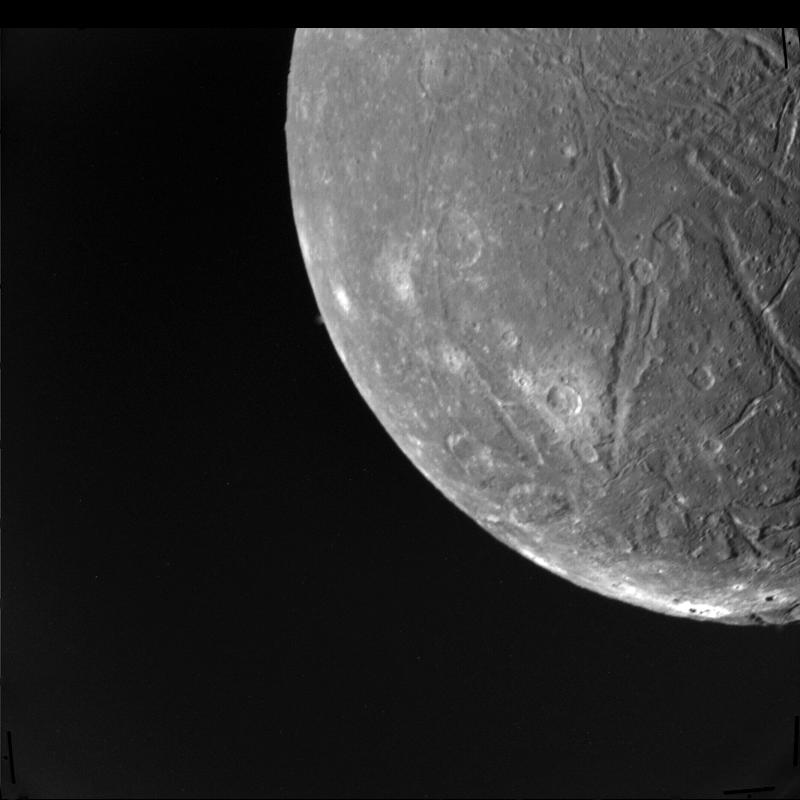
The brightest Uranian moon
Ariel reflects more light than Uranus's other large moons. Its surface includes extensive networks of valleys, ridges and chasms, some of which cut through older impact terrain.
The relative scarcity of large craters in the youngest regions suggests that geological activity resurfaced parts of Ariel after the heaviest period of impacts.
A history of stretching
Tidal heating, changes in the moon's orbit, or an ancient subsurface ocean may have driven the tectonic deformation. Whether any liquid remains today is unknown.
Voyager 2 saw only one hemisphere at useful resolution. A return mission to Uranus would reveal whether Ariel's canyon networks are still changing.
Worth knowing
Ariel is named after a spirit in Shakespeare's The Tempest.
It is the brightest of Uranus's five major moons.
Voyager 2 imaged only about 35% of Ariel's surface at useful resolution.
Watch and explore
-
Ariel: Uranus's Bright Ice Moon Rätsel des Universums
The video loads from YouTube only when you open the card.
Research & further reading
Mission imagery and measurements are interpreted alongside orbital data. Follow the source links for the current NASA overview and precise satellite parameters.