Icy moon of SaturnBright wisps over ancient scars
Dione
Dione combines a cratered ancient landscape with bright fractures and clues to an ocean deep below.
- Host
- Saturn
- Type
- Icy moon
- Mean diameter
- 1,123 km
- Mean orbital radius
- 377,400 km
- Orbital period
- 2.74 days
- Surface gravity
- 0.232 m/s²
- Key feature
- Wispy terrain
- Ocean evidence
- Possible subsurface ocean
Dione up close
NASA imagery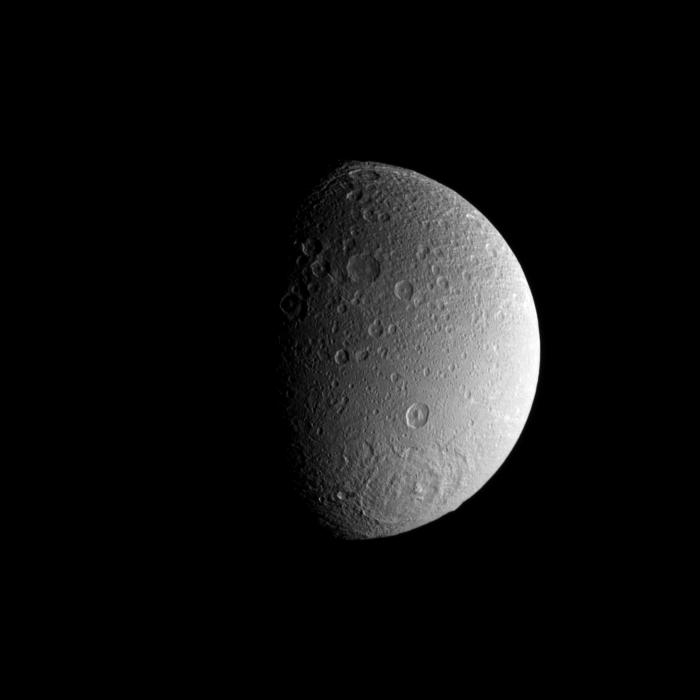
Wispy terrain
Early Voyager images showed bright streaks across Dione, initially called wispy terrain. Cassini later showed that these are networks of deep ice cliffs rather than surface frost.
The fractures cut through older cratered plains. Their orientation records stresses in the moon's outer ice shell, likely linked to its history of tidal deformation.
A hidden ocean?
Cassini gravity measurements and the shape of Dione's ice shell suggest that a global liquid ocean could lie beneath a rigid outer layer. The evidence is weaker than at Enceladus, so the debate continues.
Dione orbits in resonance with Enceladus and helps influence the Saturnian system's tidal dynamics. Small Trojan moons share its orbit, adding to the moon's complex gravitational neighbourhood.
Worth knowing
Dione was discovered by Giovanni Cassini in 1684.
Its bright fractures are cliffs of nearly pure water ice.
The small moons Helene and Polydeuces travel with Dione around Saturn.
Watch and explore
-
Why Saturn's Moon Dione Cracked Open Astrum
The video loads from YouTube only when you open the card.
Research & further reading
Mission imagery and measurements are interpreted alongside orbital data. Follow the source links for the current NASA overview and precise satellite parameters.