Largest moon in the Solar SystemA moon with its own magnetic field
Ganymede
Ganymede is larger than Mercury, hides an ocean beneath ancient ice and generates a magnetic field of its own.
- Host
- Jupiter
- Type
- Large icy moon
- Mean diameter
- 5,268 km
- Mean orbital radius
- 1,070,400 km
- Orbital period
- 7.15 days
- Surface gravity
- 1.43 m/s²
- Magnetic field
- Intrinsic global field
- Ocean evidence
- Subsurface saltwater ocean
Ganymede up close
NASA imagery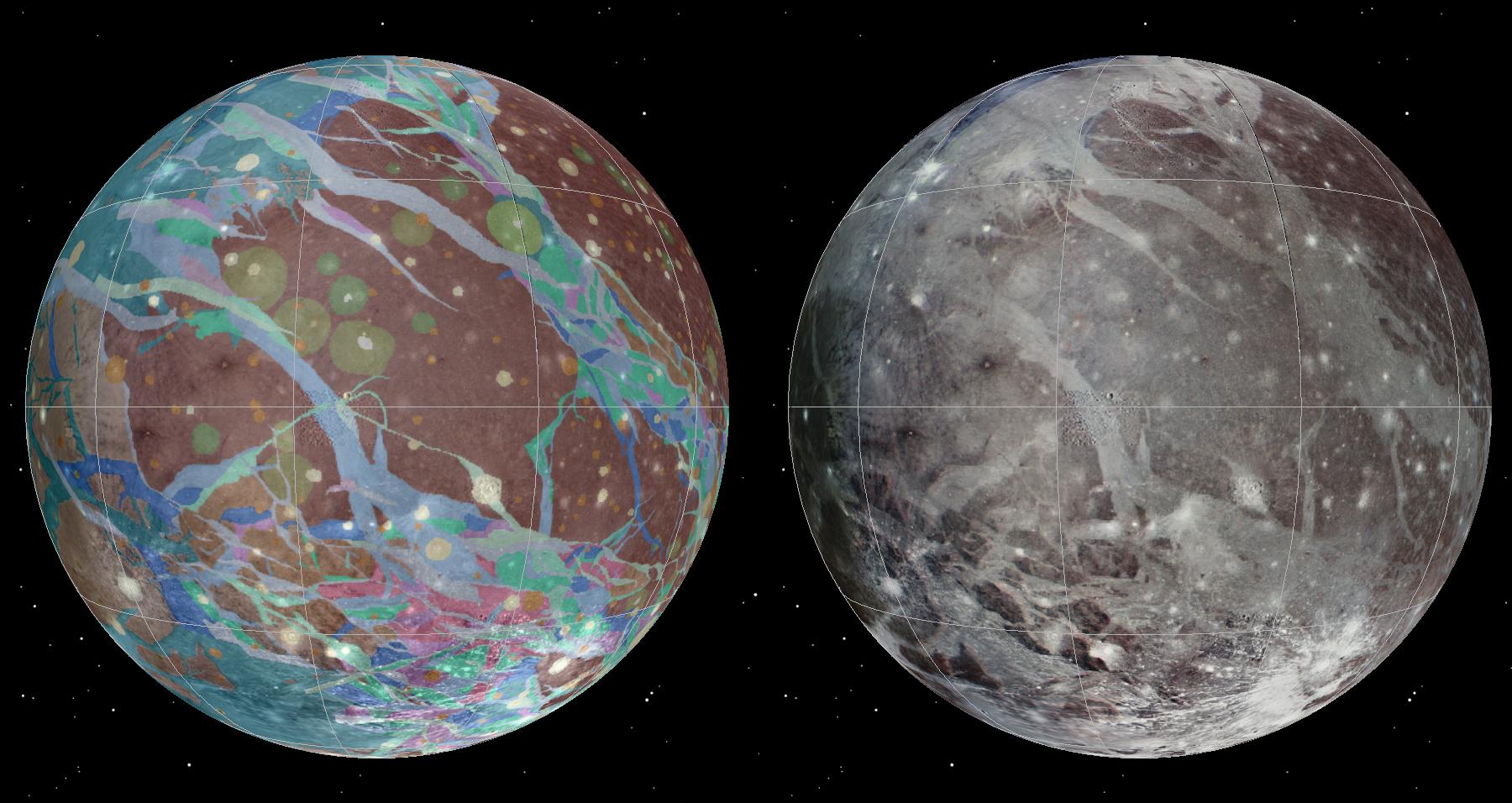
A moon larger than Mercury
Ganymede's diameter is about 5,268 kilometres, making it larger than Mercury, though it contains much more ice and has a lower density than the rocky planet.
Its surface mixes dark, heavily cratered terrain with brighter grooved regions. The grooves and faults record episodes of tectonic and possibly cryovolcanic activity.
An ocean and a magnetosphere
Magnetic and gravity measurements point to a salty ocean deep below an outer ice shell. The ocean may be sandwiched between layers of high-pressure ice.
Ganymede is the only moon known to generate its own magnetic field. Its aurorae rock back and forth as Jupiter's field interacts with this internal dynamo, providing a way to probe the hidden ocean.
Worth knowing
Ganymede is larger than Mercury but a little more than half its mass.
Its name comes from a cupbearer of the Greek gods.
ESA's JUICE spacecraft is designed to enter orbit around Ganymede in the 2030s.
Watch and explore
-
Juno Flies Past Ganymede NASA
The video loads from YouTube only when you open the card.
Research & further reading
Mission imagery and measurements are interpreted alongside orbital data. Follow the source links for the current NASA overview and precise satellite parameters.