Irregular moon of SaturnA sponge-shaped world
Hyperion
Hyperion is a jumbled, porous moon whose irregular shape and chaotic rotation refuse to behave like most satellites.
- Host
- Saturn
- Type
- Irregular icy moon
- Mean diameter
- About 270 km
- Mean orbital radius
- 1,481,100 km
- Orbital period
- 21.28 days
- Rotation
- Chaotic
- Density
- Unusually low
- Discovered
- 1848 · William Bond and George Bond
Hyperion up close
NASA imagery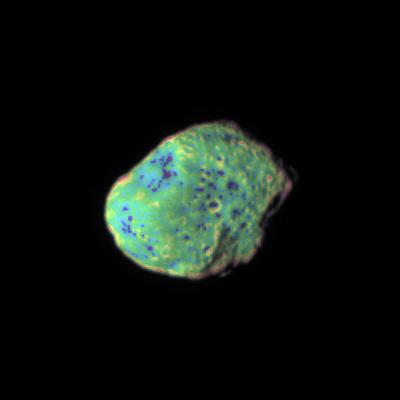
Porosity and pits
Hyperion's low density implies a highly porous interior: a rubble-rich body with substantial empty space between its fragments. Its surface is covered in sharp-rimmed pits rather than ordinary fresh craters.
Dark material fills the bottoms of many depressions. This may be dust rich in organic compounds, perhaps inherited from elsewhere in the Saturnian system.
Tumbling through orbit
Hyperion does not rotate predictably. Its irregular shape and gravitational interaction with Titan leave it tumbling chaotically, with its spin orientation changing over time.
The moon resides just outside a 4:3 orbital resonance with Titan. That resonance may have driven the breakup of an earlier moon, supplying Hyperion with debris or contributing to its irregular structure.
Worth knowing
Hyperion has one of the most unusual rotations of any Solar System moon.
Its density is roughly half that of water ice, largely because of internal porosity.
It was discovered independently by two teams on the same night in 1848.
Watch and explore
-
Saturn's Moon Hyperion Is More Than 40% Empty Space Space Scope
The video loads from YouTube only when you open the card.
Research & further reading
Mission imagery and measurements are interpreted alongside orbital data. Follow the source links for the current NASA overview and precise satellite parameters.