Distant moon of NeptuneA moon on a very strange path
Nereid
Nereid follows one of the most eccentric orbits of any major planetary moon, suggesting a history of capture or disruption.
- Host
- Neptune
- Type
- Small irregular moon
- Mean diameter
- About 340 km
- Mean orbital radius
- 5.51 million km
- Orbital period
- About 360 days
- Orbital eccentricity
- About 0.75
- Rotation
- Possibly irregular
- Discovered
- 1949 · Gerard Kuiper
Nereid up close
NASA imagery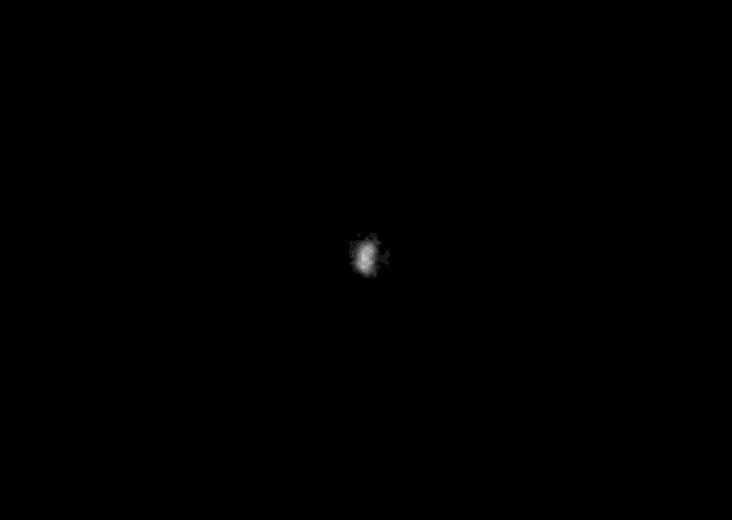
An eccentric orbit
Nereid's distance from Neptune varies by a factor of several during each orbit. At its closest it is roughly 1.4 million kilometres from the planet; at its farthest it can be more than 9 million kilometres away.
The large eccentricity is unusual for a regular moon and points to a dramatic past. Nereid may have been captured or scattered by Triton during Triton's arrival in the Neptunian system.
A difficult target
Voyager 2 passed Neptune during a rapidly changing sequence in 1989. Nereid was then far from the spacecraft, so most images show only a small disk at low resolution.
The moon rotates irregularly and may have formed from the fragments of a disrupted moon. Its surface, composition and exact shape remain poorly known without a dedicated mission.
Worth knowing
Nereid was discovered by Gerard Kuiper in 1949, decades before Voyager 2 reached Neptune.
It has one of the most eccentric orbits of any planetary moon.
Nereid is named after the sea nymphs of Greek mythology.
Watch and explore
-
Nereid: Neptune's Moon Cloudy
The video loads from YouTube only when you open the card.
Research & further reading
Mission imagery and measurements are interpreted alongside orbital data. Follow the source links for the current NASA overview and precise satellite parameters.