Dark moon of NeptuneA world almost round
Proteus
Proteus is a dark, irregular moon that teeters on the threshold between a lumpy asteroid and a round planetary world.
- Host
- Neptune
- Type
- Large irregular moon
- Mean diameter
- About 420 km
- Mean orbital radius
- 117,647 km
- Orbital period
- 1.12 days
- Surface gravity
- About 0.07 m/s²
- Surface
- Dark, cratered, non-spherical
- Discovered
- 1989 · Voyager 2
Proteus up close
NASA imagery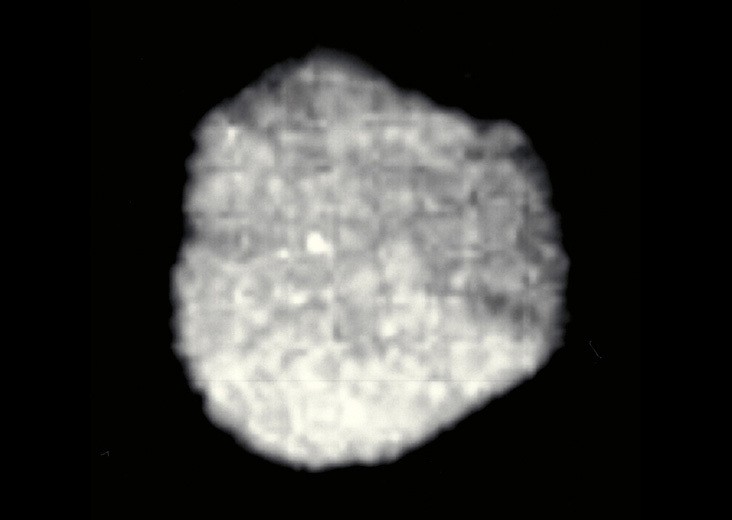
Almost round
Proteus is large enough to be nearly spherical but retains an irregular, box-like outline. Its shape suggests it formed low in the debris disk around Neptune and never gathered enough additional mass to fully settle into a sphere.
Its dark surface is heavily cratered, including the large impact structure Pharos. The moon is much darker than Neptune's nearby moon Triton.
A survivor of Neptune's history
Proteus is one of the largest inner moons in the Solar System and one of the darkest. Its low inclination and nearly circular orbit indicate that it formed in the regular satellite system rather than being captured.
Triton's backwards orbit and capture history would have disturbed the Neptunian system. Proteus offers a way to study how the surviving regular moons were affected by that event.
Worth knowing
Proteus was named after a shape-shifting sea god in Greek mythology.
It was discovered from Voyager 2 images in 1989 and confirmed shortly afterward.
The moon was almost missed because it is so dark and close to Neptune.
Watch and explore
-
Proteus: Neptune's Mysterious Moon Factoids
The video loads from YouTube only when you open the card.
Research & further reading
Mission imagery and measurements are interpreted alongside orbital data. Follow the source links for the current NASA overview and precise satellite parameters.