Supermassive black holeVirgo Cluster
M87*
The first black hole ever pictured: a six-billion-solar-mass giant at the centre of Messier 87, wrapped in a ring of million-degree plasma.
- Type
- Supermassive black hole
- Mass
- About 6.5 billion M☉
- Distance
- About 55 million light-years
- Host
- Messier 87 (Virgo A)
- First image
- Event Horizon Telescope, 2019
- Accretion state
- Low accretion rate; active jet
The first black-hole image
EHT Collaboration / NASA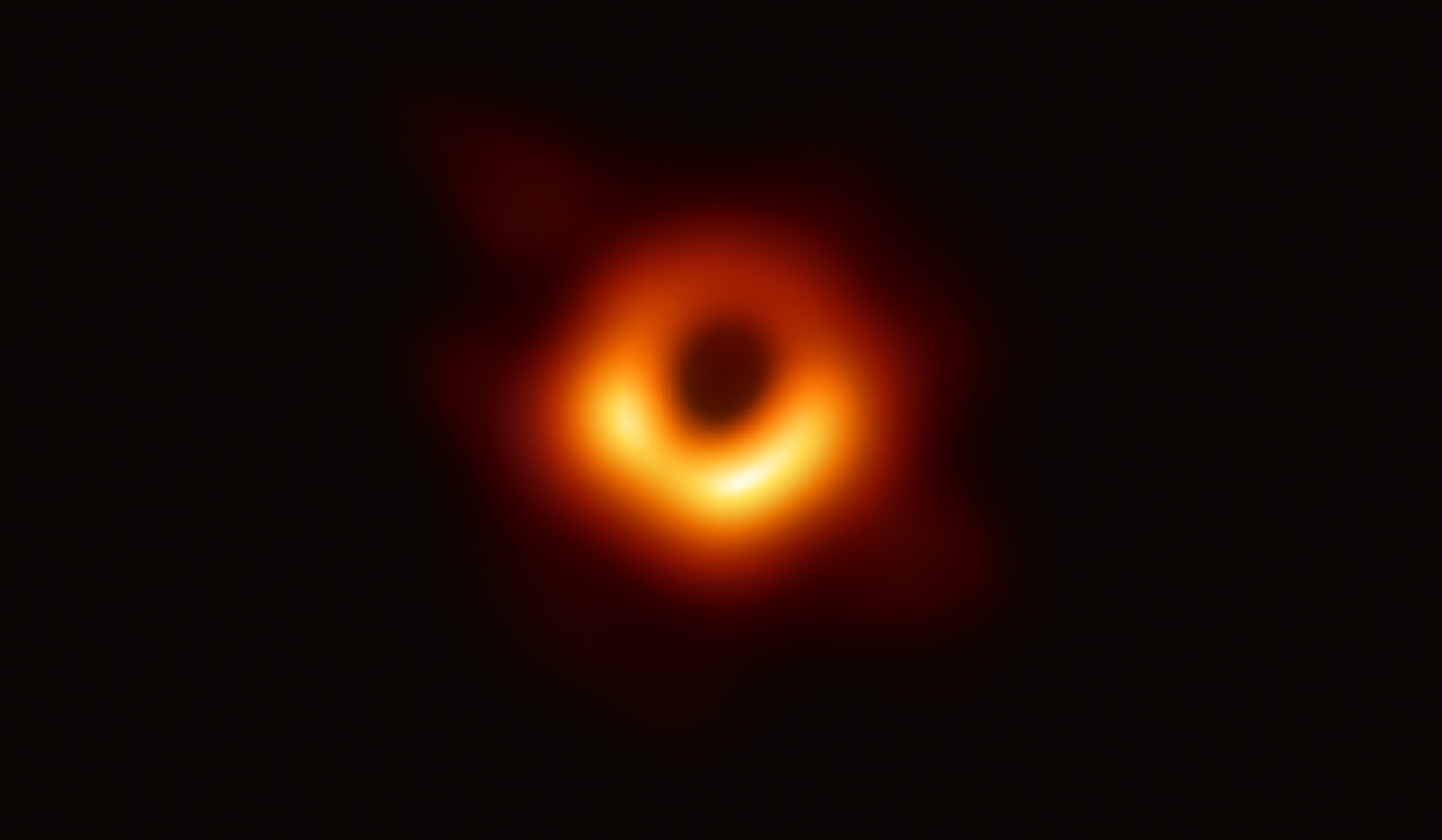
The first image of a black hole
In April 2019, the Event Horizon Telescope collaboration released an image of the shadow of M87*: a dark central region surrounded by a bright, asymmetric ring of radio emission. The ring is not the black hole itself but the hot plasma around it, bent by gravity.
The image required radio telescopes across the world observing together as one Earth-sized instrument. Its resolution was sharp enough to resolve a region roughly the size of the Solar System at a distance of 55 million light-years.
A giant at the heart of Virgo A
M87* sits in the centre of Messier 87, a giant elliptical galaxy in the Virgo Cluster. Its mass has been measured at several billion Suns, making it one of the largest black holes accessible to direct imaging.
Most of the galaxy's starlight is old and smooth, but the centre is active: gas falling toward the black hole powers a jet that extends thousands of light-years into space.
The jet
M87's jet was first noticed in photographs more than a century ago. Material is accelerated close to the speed of light and launched outward in a narrow beam, visible across radio, optical and X-ray wavelengths.
The jet is one way a black hole shapes its host galaxy: it carries energy and momentum far beyond the event horizon, heating gas and influencing where new stars can form.
Why it matters
M87* provided a direct test of the black-hole prediction at the centre of a galaxy. Continued observations track the ring's brightness and shape, helping astronomers understand how matter falls onto a supermassive black hole and how jets are launched.
Worth knowing
M87* was the first black hole ever imaged, in 2019.
It weighs about 6.5 billion Suns.
The imaged shadow is larger than the event horizon itself.
Recommended pop-science media
-
First Image of a Black Hole! Veritasium
-
Inside the black hole image that made history TED
Videos are embedded from YouTube and load only when you open a card.