StarSolar System
The Sun
A middle-aged G-type star holding 99.86% of the Solar System’s mass. Its fusion core powers the light, heat, solar wind, and magnetic storms that shape every world around it.
- Star type
- G2V main-sequence star
- Mass
- 1.989 × 1030 kg · 333,000 Earths
- Mean radius
- 695,700 km · 109 Earths
- Surface temperature
- About 5,772 K
- Core temperature
- About 15 million K
- Luminosity
- 3.828 × 1026 W
- Rotation
- About 25 days at the equator; 35 days near the poles
- Age
- About 4.6 billion years
A star powered by fusion
The Sun’s core is hot and dense enough for hydrogen nuclei to fuse into helium. That process releases energy, roughly 600 million tonnes of hydrogen are converted every second, and the pressure it creates holds the star against gravity.
Energy leaves the core as gamma rays and scattered particles, then spends tens of thousands of years working outward through the radiative and convective zones. Once it reaches the visible surface, sunlight crosses the 1 AU to Earth in about 8 minutes 20 seconds.
The surface is not a surface
The bright disk we see is the photosphere, a layer of plasma about 500 km thick. Above it sit the chromosphere and the corona. The corona is far hotter than the photosphere, several million kelvin rather than about 5,772 K, and explaining that temperature inversion remains the coronal-heating problem.
The Sun is often called a yellow dwarf, but its light is close to white. “G2V” describes its spectral class and main-sequence stage; the yellow tint in many images comes from filters, atmospheric scattering, or artistic colour choices.
A magnetic engine
The Sun’s outer layers rotate at different rates, and that differential rotation winds its magnetic field into knots. Sunspots mark where strong fields suppress convection. The field reverses polarity roughly every 11 years, producing the familiar solar cycle.
When stressed magnetic fields reconnect, they can release flares and coronal mass ejections. The solar wind carries charged particles outward at hundreds of kilometres per second. When a gust reaches Earth, it can drive auroras, disturb radio links, and stress satellites and power grids.
The Sun in ultraviolet light
NASA/SDO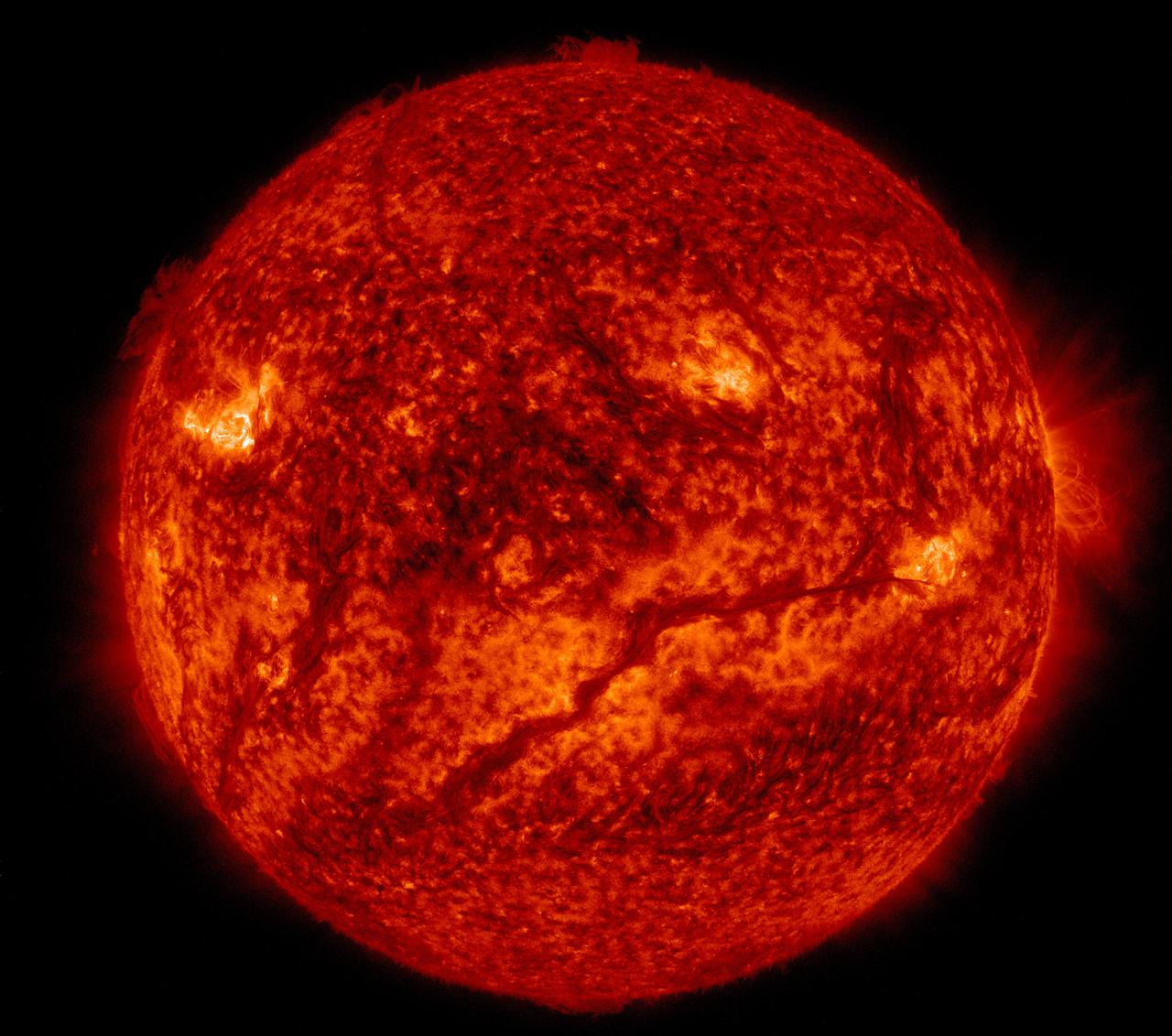
How we watch it
The Sun is now observed continuously from space and from the ground. NASA’s Solar Dynamics Observatory images the entire disk in several ultraviolet wavelengths; Solar Orbiter and Parker Solar Probe sample the inner heliosphere and the corona itself; and observatories such as DKIST resolve fine structure at the surface.
- Parker Solar Probe flies inside the outer corona to measure particles and magnetic fields close to their source.
- Solar Orbiter combines remote sensing with in-situ measurements and increasingly tilted orbits over the poles.
- SDO and SOHO provide long, continuous records of flares, sunspots, and coronal mass ejections.
- DKIST studies the photosphere and chromosphere at the highest ground-based resolution.
Why it matters
The Sun is the source of nearly all the energy available at Earth’s surface. It also controls the heliosphere, the bubble of plasma that shields the Solar System from much of the interstellar medium. Understanding its magnetic cycles and eruptions is essential for forecasting space weather and protecting the technology we rely on.
Recent publications
| Year | Paper | Venue | Link |
|---|---|---|---|
| 2026 | Measured energy exchange in coronal hole solar wind from its solar origins to the heliosphere | arXiv preprint | arXiv |
| 2026 | Characterizing the Martin Luther King Event: Sun to Earth Evolution of the January 19, 2026 Geomagnetic Storm | arXiv preprint | arXiv |
| 2026 | First results from PADRE/MeDDEA: X-rays from a flare and its CME | arXiv preprint | arXiv |
| 2025 | What are Switchbacks? | arXiv preprint | arXiv |
| 2025 | Velocity-space turbulent cascade in the near-Sun solar wind: first insights from the Parker Solar Probe mission | arXiv preprint | arXiv |
Compiled 20 October 2026. Preprints are labelled; links resolve to the arXiv record.